How does social context mediate patterns of information flow and decision-making in the wild?
Garden Eel Colonies
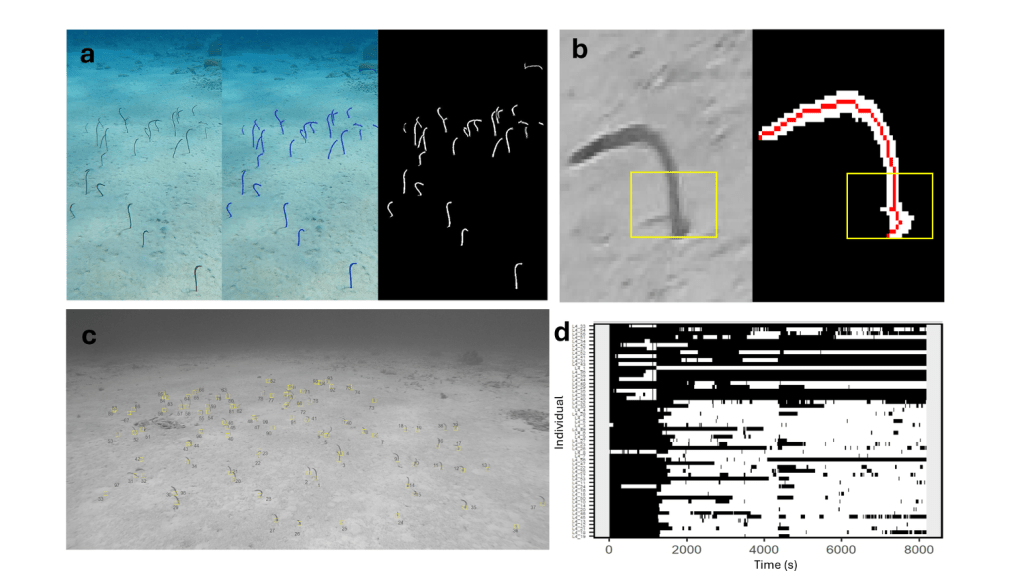
Social context is a key mediator of behavioral decisions, influencing how individuals perceive and respond to their environment. Substantial theoretical and empirical work has demonstrated the significance of social information in underpinning emergent behaviors such as collective foraging and predator evasion. In efforts to gain a general mechanistic understanding of collective behavior, the field has focused on the average performance of homogenous groups over short-time scales in the laboratory. The capacity for social information transfer, however, varies with group size, composition, and topology. We know little, therefore, about natural variation in the collective behavior of wild animal groups. The fixed colonies of brown garden eels (Heteroconger longissimus) offer a remarkable opportunity to study how network characteristics translate to behavioral differences. This zooplanktivorous fish follows an unusual lifestyle, entailing anchorage of the posterior part of their body to the sides of burrows in the seabed near others, enabling individuals to be tracked across months and years. I use long-term observation and field experiments processed using computer vision approaches to understand how variation in colony size and topology influence individual and colony-level behavior.
Western Tent Caterpillars
One of the PhD students, Sam Rothberg, is currently studying the ecology and evolution of social grouping using western tent caterpillars (Malacosoma californicum) as a study species. Tent caterpillars spend larval development living in silk “tents” that they spin with their group mates. While they originally live with and construct tents with siblings, as they get older, groups may combine with each other into larger and less related groups. I am interested in understanding this process of group merging because of the ways in which it does not fit cleanly with many existing theories of social behavior. I am conducting experiments asking whether groups of relatives behave differently from mixed family groups, and whether merging can explain aspects of the evolutionary stability of grouping in this species. All the work for these projects takes place on popular trails in Boulder, CO, so I have also appreciated the opportunity to talk to hikers about insect social lives.
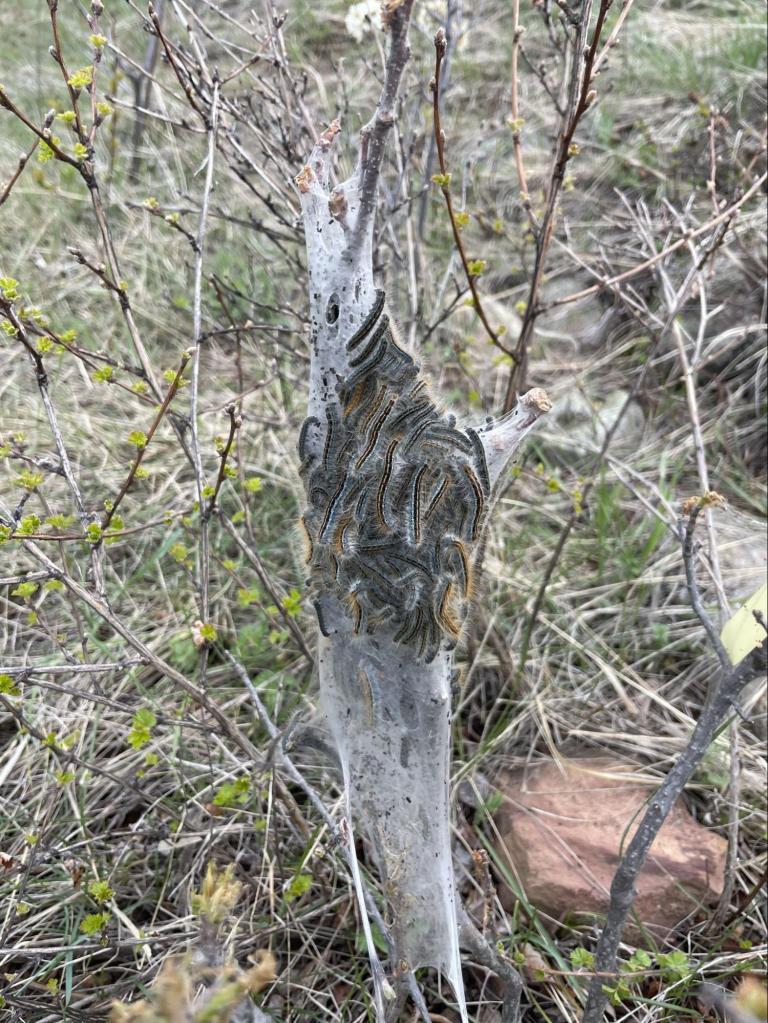
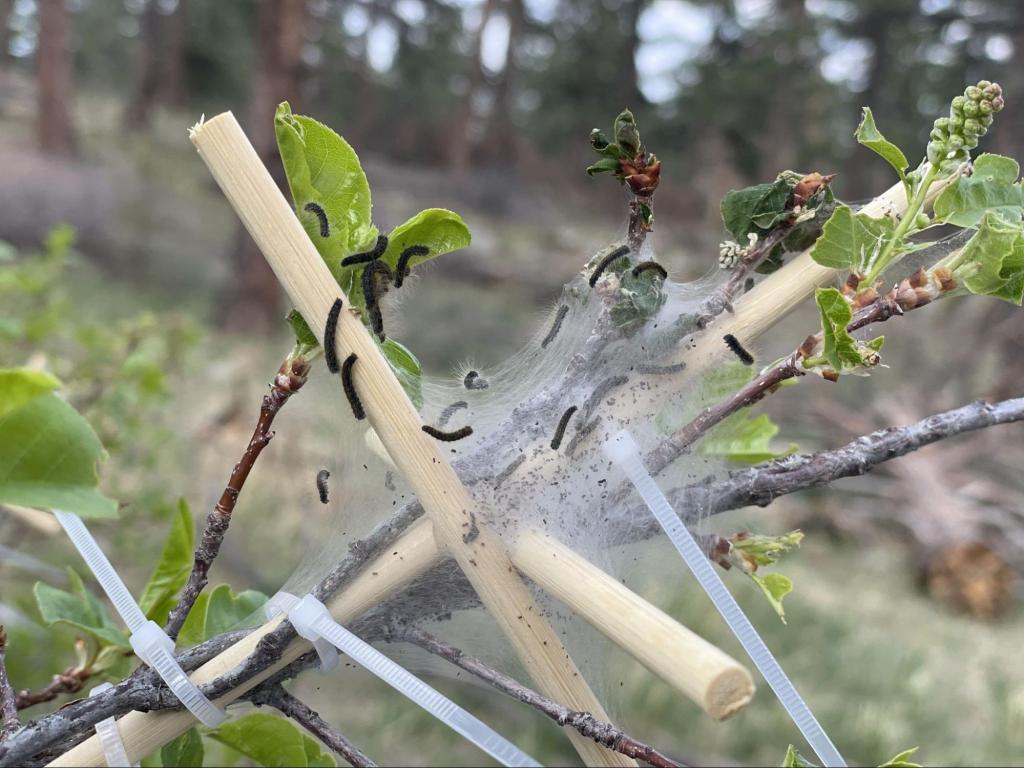
Above are some of the Western Tent Caterpillars around Boulder, Colorado.
 Gil Lab